


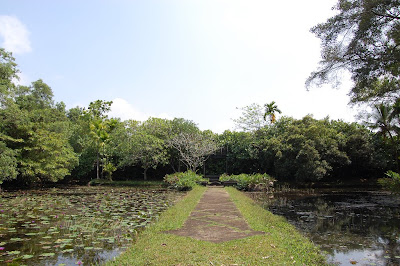


Lunuganga, Bentota near the south western coast of Sri Lanka is a distant retreat, an outpost on the edge of the known world, a civilized garden within the larger wilderness of Sri Lanka, transforming an ancient rubber estate into a series of outdoor rooms that evoke memories of Sacro Bosco and Stourhead. The town house, in contrast, is an introspective assemblage of courtyards, verandas and loggias, created by knocking together four tiny bungalows and adding a white entry tower that peers like a periscope across neighbouring rooftops towards the distant ocean. It is a haven of peace, an infinite garden of the mind, locked away within a busy and increasingly hostile city."
Lunuganga, country house hotel
In 1948 Geoffrey Bawa, then a newly qualified lawyer freshly returned from Europe, bought an abandoned rubber estate on a promontory overlooking the Deduwa Lake, a few miles inland from Bentota on the south western coast of Ceylon and christened it ‘Lunuganga’ or Salt River. His ambition was to create a tropical version of an Italian renaissance garden, and it was this project which inspired him to abandon the law and study architecture, becoming eventually one of the most important Asian architects of the 20th C. Over the next fifty years he spent almost every available weekend at his country retreat and slowly fashioned into a place of extraordinary beauty. Lunuganga was for him a place where he could retire from the travails of the city and entertain a few chosen friends, but it was also a place where he could experiment with new ways of creating landscapes and relating buildings to their surroundings.
A country home hotel open to visitors & guests
When Geoffrey Bawa finally died in 2003 he was cremated on the summit of the Cinnamon Hill at the heart of Lunuganga and his ashes were scattered across the garden which he so loved. Since then his estate has been managed by a group of his friends who form the ‘Lunuganga Trust’. The Trust exists in part to manage and conserve the Lunuganga estate garden as well as No.11 Bawa’s town house in Colombo., and both are now open to the public for guided tours . In addition Lunuganga is now run as a country house hotel where guests can experience the same gracious hospitality meted out by Geoffrey Bawa to his friends and can eat the same simple but delicious food prepared by his old cook, Catherine.
Endless vistas
The garden occupies fifteen acres of land, bounded on two sides by the waters of the lake, and is set out like a series of spacious outdoor rooms whose positions have been carefully chosen to exploit an astonishing variety of vistas. A bewildering network of secret pathways, framed by a rich variety of trees and shrubs and punctuated by shady pavilions and beckoning statues, links the different spaces and leads the visitor on a seemingly endless selection of wonderful promenades.


